
The difference between Alkaline and Lithium Cells
The Alkaline battery gets its name because it has an alkaline electrolyte of potassium hydroxide, instead of the acidic ammonium chloride or zinc chloride electrolyte of zinc-carbon batteries.
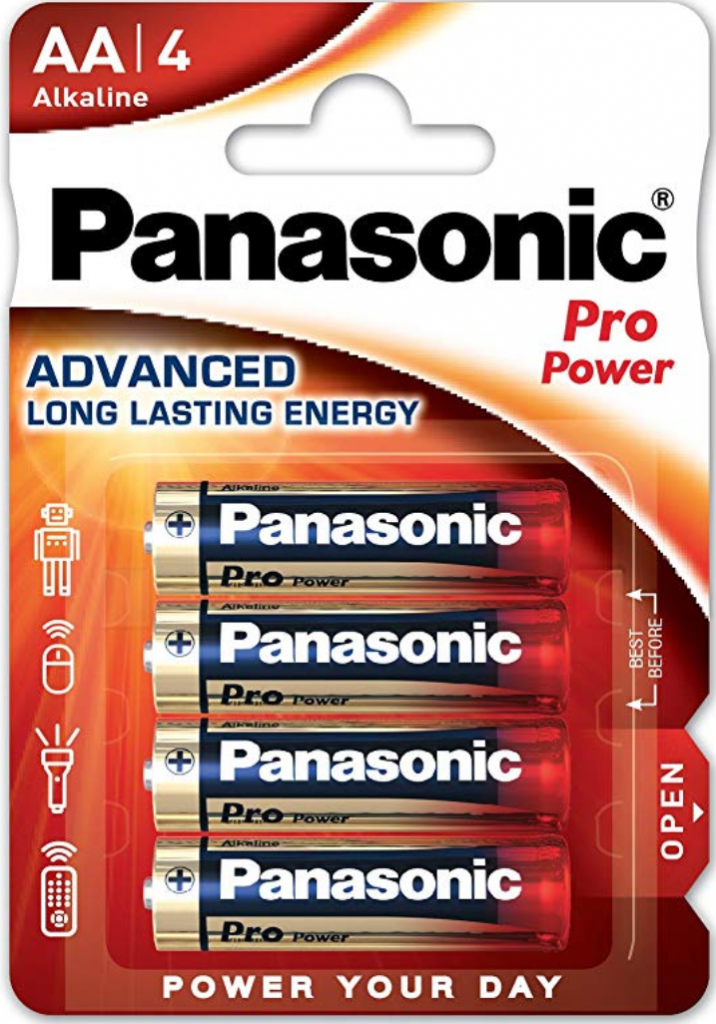

Above, you see pictures of two types of cells that Panasonic makes. The ones on the top are AA type Alkaline cells. The ones on the bottom are AA type Zinc Carbon cells.


Based on the tables above, the Zinc Carbon cell is lighter, but has a lower shelf life. They both are AA type and have a nominal voltage of 1.5V, but there is one point of comparison that is not listed in the table above. That is Capacity.
The Capacity of a AA cell depends on the load connected to it. For example, if you discharge the AA cell at 1A, it might discharge for say 1 hour. Now what if you discharged it at 0.5A, will it discharge for 2 hours? The answer is no, the effective capacity at 0.5A will be slightly higher, so the cell will be able to supply for a little more than 2 hours.
This is depicted by the table below for an Alkaline cell –
| Capacity (%) | 100 | 90 | 80 | 70 | 60 | 50 | 40 | 30 | 20 | 10 | 0 |
|---|---|---|---|---|---|---|---|---|---|---|---|
| Zero-load (V) | 1.6 | 1.45 | 1.38 | 1.34 | 1.32 | 1.30 | 1.28 | 1.26 | 1.23 | 1.20 | 1.10 |
| 330 mW load (V) | 1.49 | 1.35 | 1.27 | 1.20 | 1.16 | 1.12 | 1.10 | 1.08 | 1.04 | 0.98 | 0.62 |
Ref: Texas Instruments
If the device you have connected to the cell has a cut-off voltage at 1.1V, at zero load the discharge it will cut-off at 0% capacity, whereas at 330mW load it will cutoff at 40% capacity.
So, capacity varies with discharge current.

The graph above shows the discharge characteristics for the Panasonic Zinc Carbon cell. With the selected load and discharge curve selected (15s ON, 45s OFF and repeat), the cell was able to run for 70 cycles before reaching the end voltage. If you buy this cell thinking that it will run your device for 70 days, you may be underestimating or overestimating depending on the load your device puts on the cell.
Now that you’ve understood the relationship between Capacity and Discharge Current, lets assume a constant discharge current. Which cell, Alkaline or Zinc Carbon performs better?
Zinc Carbon cells are typically good for use in applications that require low current draw, and they are cheaper than their Alkaline counterparts. So it is more likely for an Alkaline cell to perform better, which means it will be able to deliver higher currents and more discharge cycles.
Let’s now consider Lithium cells. These are typically high energy density rechargeable cells good for use in high drain applications.


Based on the graph above, it can be seen that for a 1W discharge, which for a 1.5V nominal cell is approximately 600mA of constant discharge current, the Lithium cell lasts for more than 4 hours, whereas the Alkaline cell lasts for 1 hour.

Considering the overall picture, based on the table above it can be seen that Lithium performs better than its Alkaline counterpart, but also costs about 50% more. At the time of writing this article, a 4 pack Energizer AA Lithium costs around $8.5 CAD, and a 4 pack Energizer Alkaline costs around $5.2 CAD.
It is very nice article to understand the difference between Lithium and Alkaline batteries
Many thanks for sharing your best knowledge about batteries on this article. Keep up the great writing.
But is it true that Lithium-ion batteries need rare earth elements that are quite destructive to the environment due to the extraction process involved for their production?
It is a really good article that explains to difference between alkaline and lithium cell. Well researched and understood the content.
Thanks for sharing informative article.